
Fire Statistics By State
Fire season is upon us.
The National Interagency Fire Center’s (NIFC) 2012 statistics ranking number of fires by state, placed both Texas (10,620 fires, 97 prescribed) and California (7,950 fires, 632 prescribed) at the top of the list. At the bottom with the lowest fire risk last year were Hawaii (2 fires, 0 prescribed), Mississippi (10 fires, 9 prescribed), and Iowa (10 fires, 98 prescribed).
What is a prescribed fire? A prescribed fire, or controlled burn, is a fire started and overseen by fire control authorities for the purpose of hazard prevention and reduction, control of greenhouse gas emissions, and promotion of germination and forest renewal. It is an essential part of forest and grassland ecology and keeps us safe from wildfires that are not monitored and have the tendency to burn hotter and become much more dangerous.
Why are certain areas more at risk than others? Generally, this is dependent on the climate and precipitation of individual areas. Drought is a big factor in becoming a high risk state.

2013 started off with a dry winter in the South-Western region of the US. Receiving only 25% of their average rainfall has put states from California to Texas, and up through the four-corners area in position for a higher risk season this year. The risk is partially caused by a temperature increase due to global warming, but there are stronger factors at work.
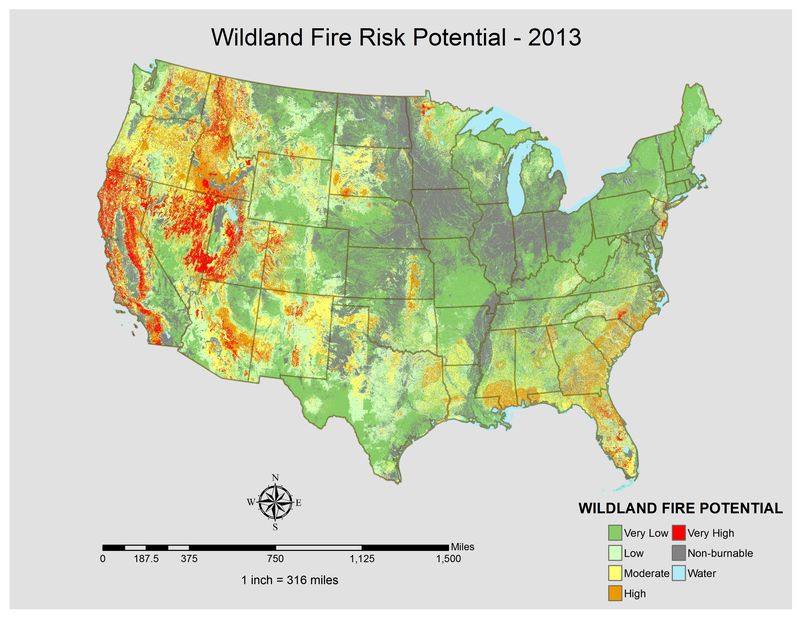
The most common cause of wildfire is lightening. When lightning strikes an area with kindling such as dry grasses or leaves, in conjunction with oxygen it creates what is know as a fire triangle or combustion triangle. The Western US is currently being referred to as having tinderbox-dry conditions, as seen in the USDA Forest Service Map below, which are ideal for this sort of event. Other causes fall into the hands of civilians including powerline arcs, machinery sparks, arson and general carelessness.
Residential fires are another story, and can be prevented.
The top three causes of residential fires:
- Cooking fires: often due to general carelessness like leaving an open flame unattended.
- Heating fires: usually occurring in family homes rather than apartments due to a heating system that isn’t properly maintained.
- Arson
Most residential fires are started in the kitchen, but the bedroom and living room aren’t close behind with burning candles and malfunctioning electronics. These fires can happen anywhere, but their likelihood of spreading can be dependent on outside influences including environmental conditions.
Understanding the types of fires and their causes can aid in knowing what can be done to prevent fire risks in your region and at home. The NIFC (www.nifc.gov) and National Fire Protection Association (www.nfpa.org) websites are good places to start when concerned about fire safety and local risk factors.